Serving Clients Nationwide.
Schedule A Consultation

CMS Is Asking What Counts as a ‘Reasonable and Relevant’ PBM Contract Term. Pharmacies Have Until November 23 to Weigh In.
About the Author: Mark D. Boesen, J.D., Pharm.D., is an attorney and a founding partner of Boesen & Snow Law.
On September 24, 2026, the Centers for Medicare & Medicaid Services published a Request for Information in the Federal Register asking a question many independent pharmacies have raised for some time: what should actually count as a “reasonable and relevant” contract term between a Part D plan sponsor and a network pharmacy?
To be assured consideration, comments must be received by November 23, 2026. Any pharmacy can submit a comment, and this is one point in the process where a pharmacy’s own operating experience can be considered.
What CMS Is Actually Doing Here
Section 6223(a) of the Consolidated Appropriations Act, 2026, Pub. L. No. 119-75, 140 Stat. 173, 664–65 (2026), amended the Social Security Act’s any-willing-pharmacy provision, Social Security Act § 1860D-4(b)(1)(A), 42 U.S.C. § 1395w-104(b)(1)(A) (last visited Oct. 7, 2026). As CMS describes the change in the RFI, the amended provision does two things. First, Part D plan sponsors must permit any pharmacy that meets the plan’s standard contract terms and conditions to participate as a network pharmacy. Second, and more consequential, for plan years beginning on or after January 1, 2029, those standard terms and conditions must be reasonable and relevant according to standards established by the Secretary of Health and Human Services. See Request for Information; Medicare Part D Reasonable and Relevant Pharmacy Contracting Standards, 91 Fed. Reg. 60,568 (Sept. 24, 2026).
The phrase “reasonable and relevant” is not new. It appears in the Part D regulations at 42 C.F.R. § 423.505(b)(18) (last visited Oct. 7, 2026). What is new is that CMS now has to establish standards for it. As the RFI explains, CMS has not established additional requirements for what makes terms reasonable and relevant; in a 2005 final rule, it clarified that standard terms could vary by geography and pharmacy type, provided similarly situated pharmacies were offered the same standard terms. 91 Fed. Reg. at 60,568.
The statute gives the Secretary until the first Monday in April 2028 to establish those standards, and required an RFI first, no later than April 1, 2027. This is that RFI, issued under file code CMS-4217-NC in docket CMS-2026-3037.
Why This Particular RFI Deserves a Pharmacy’s Attention
The questions CMS is asking are specific. The RFI is organized into eight areas of focus, and several of the issues it raises are ones many pharmacy owners have raised themselves. Among them:
- Reimbursement and dispensing fees. How Part D rates compare to actual acquisition cost, how often MAC lists are updated and what dispute mechanisms exist, whether dispensing fees cover the real cost of dispensing, and the gap between the negotiated price shown on a claim response and what a pharmacy actually keeps after effective-rate reconciliation.
- Contracting practices. Deemed acceptance and negative-consent provisions, how much time pharmacies and their PSAOs get to review rate sheets and amendments before acceptance is deemed, mid-contract changes to reimbursement parameters, and the use of provider manuals and policy bulletins to modify standard terms outside any formal contract amendment.
- Where the real terms live. CMS asks specifically about financial terms contained in documents other than the executed contract: rate sheets, internal budget files, side letters, and unwritten understandings between affiliated entities.
- Specialty designation and vertical integration. Whether limited or exclusive specialty networks and PBM specialty designations overlap with common ownership between the PBM and the pharmacy it designates, and whether CMS should establish standards for defining “specialty pharmacy.”
- Auditing practices. Audit frequency and type, transparency of recoupment methodology on a per-claim basis, extrapolation methods, the split between clerical findings and genuine program-integrity issues, recoupment based on minor errors, corrective action, and due process.
- Quality and performance measures. What measures are used, whether they are validated or risk adjusted, whether they fall disproportionately on smaller or non-chain pharmacies, and what access to performance data and what appeal processes pharmacies have.
The auditing section in particular touches on issues pharmacies often raise, and the RFI gives pharmacies a way to place those issues in the public record.
Why a Pharmacy Would Want to Spend the Time
Rulemaking generally relies on the administrative record, and CMS encourages commenters to provide, where relevant, quantitative data, contract language (de-identified as appropriate), information broken out by pharmacy type and geography, and evidence about enrollee access. Plan sponsors and PBMs may have dedicated staff and resources for producing exactly that kind of submission. If the detailed, contract-level material in the docket comes largely from one side of the table, that is the record the 2029 standards may be built on.
A comment period can also be a comparatively low-cost way to participate in the regulatory cycle, and this one sits upstream of standards that may shape the contracts a pharmacy signs for 2029 and beyond. No single comment decides a rule. But CMS has said it will consider all input as it develops future proposals, and a docket reflecting how these contracts function at the pharmacy counter is a different starting point than one that does not.
How to Submit a Comment
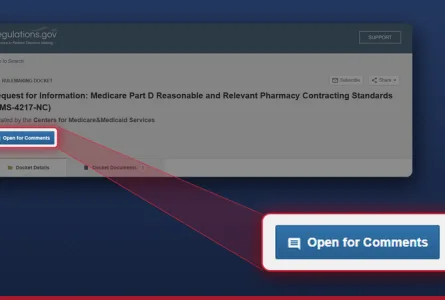
To be assured consideration, comments must be received by November 23, 2026, and should refer to file code CMS-4217-NC. CMS asks commenters to choose only one of three methods:
- Electronically. Through the docket at regulations.gov/docket/CMS-2026-3037 (last visited Oct. 7, 2026), following the “Submit a comment” instructions. This is the route many pharmacies are likely to use.
- Regular mail. Centers for Medicare & Medicaid Services, Department of Health and Human Services, Attention: CMS-4217-NC, P.O. Box 8013, Baltimore, MD 21244-8013. Build in lead time; the deadline is a receipt deadline, not a postmark deadline.
- Express or overnight mail. Centers for Medicare & Medicaid Services, Department of Health and Human Services, Attention: CMS-4217-NC, Mail Stop C4-26-05, 7500 Security Boulevard, Baltimore, MD 21244-1850.
CMS also asks commenters to identify which section of the RFI they are responding to and the circumstances their response relates to. That instruction is worth following literally: a comment organized by RFI section is easier to route and easier to weigh than a general letter covering everything at once.
Before Anything Goes Out the Door
Comments received before the close of the comment period are generally posted for public viewing, including any personally identifiable or confidential business information they contain. CMS says so plainly and instructs commenters not to include proprietary or confidential material. Three things are worth working through first:
- The PBM contract itself may limit what can be disclosed. PBM and PSAO agreements may contain confidentiality provisions covering rates, rate sheets, provider manuals, and audit correspondence. CMS invites contract language that is de-identified as appropriate, but whether a given agreement permits that, and in what form, is specific to that agreement and better answered before submission than after. Submitting material that a contract prohibits you from disclosing can expose a pharmacy to a breach claim, so have counsel review the contract before anything is filed.
- No patient information belongs in a federal docket. Claim-level detail makes a comment more persuasive, but a public comment file is the last place protected health information should surface. Aggregated figures and examples that contain no patient information generally make the same point without creating a separate compliance problem. Aggregation does not guarantee de-identification. Small counts, rare drugs, or specific dates can still point to an individual, so any figures drawn from patient records should be checked against the HIPAA de-identification standard, 45 C.F.R. § 164.514(b) (last visited Oct. 7, 2026), before filing.
- Assume the comment will be read by the other side. Posted comments are available for public viewing, including by plan sponsors and PBMs. That is not a reason to stay silent, but it is a reason to be deliberate, and it is part of why some pharmacies comment through a state or national association, a PSAO, or counsel.
What Tends to Make a Comment Useful
CMS has noted that it will post acceptable comments from multiple unique commenters even if the content is identical or nearly identical, while encouraging commenters not to submit duplicative comments. Form letters may register as volume and may be less likely to shape the text of a standard. CMS has also encouraged information disaggregated by pharmacy type, geographic location, and drug category, so a comment should say plainly what kind of pharmacy it is coming from. Beyond that, what tends to carry further:
- Specific numbers. A reimbursement spread below acquisition cost on a defined drug category, over a defined period, rather than a general statement that rates are too low.
- A described mechanism. Rather than “MAC updates are unfair,” how often a list changed mid-contract, how much notice arrived, whether a dispute process existed, and what came of it.
- A concrete audit example. What was requested, what was recouped, whether the finding was clerical or substantive, whether extrapolation was applied, and whether corrective action was offered.
- A proposed standard. CMS asks directly for contract terms or frameworks that could serve as models, and for criteria that would make standards transparent, objective, and enforceable. Answering that is often worth more than describing the problem.
Where This Leaves You
Regulatory timelines make this easy to set aside. Standards are not due until April 2028 and do not reach contracts until plan year 2029. But the record CMS may consider is being assembled now, and the window closes November 23, 2026.
Attorney Advertising. This article is provided for general informational and educational purposes only and does not constitute legal advice. Contacting Boesen & Snow Law through this article does not create an attorney-client relationship. This content may constitute attorney advertising under the laws of your state. Prior results described or referenced herein do not guarantee a similar outcome.
Boesen & Snow Law is based in Scottsdale, Arizona. We work with independent, specialty, and multi-location pharmacies nationwide on PBM audit, network, and compliance matters. Our ability to formally represent a pharmacy in a particular matter, including litigation, arbitration, or before a state board, depends on that jurisdiction’s licensure and admission requirements, which may include pro hac vice admission or association with local counsel. Contact us to confirm we can assist with your pharmacy’s specific state and matter.
Responsible attorney: Allyson Snow, J.D., Boesen & Snow Law, 14350 N. 87th St., Unit 250, Scottsdale, AZ 85260.
Phone: 602-900-8562 | Email: [email protected] | Website: https://www.boesensnowlaw.com/
Schedule a Free Consultation
Fields marked with an * are required
Attorney Advertising. This content does not constitute legal advice and does not create an attorney-client relationship. Prior results do not guarantee a similar outcome. Licensure and admission requirements vary by state and may require pro hac vice admission or local counsel.

© Copyright 2026 Boesen & Snow Law. All rights reserved.